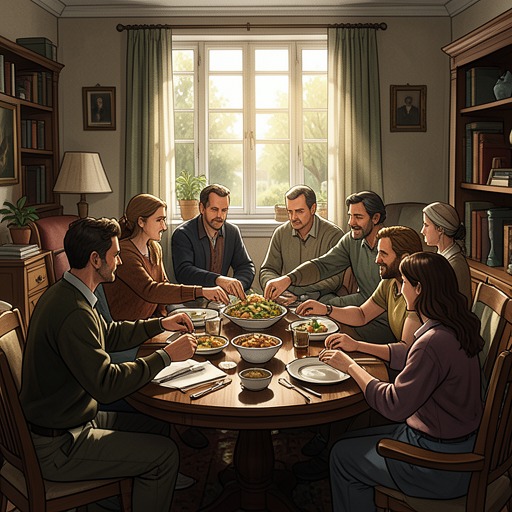
Shen Tang Reunites with the Shen Family
I’m Very Happy After Marrying the CEO Husband According to the AgreementShen Tang Reunites with the Shen Family marks the conversion of suspicion into belonging. Shen Tang learns that Shen Yu has a missing older sister, recognizes a connection with the elderly woman who had mistaken her for someone else at the hospital, and ultimately receives medical confirmation that she and the Shen family share blood. The reunion is joyful but not simple: recognition opens a place for her in a household that has preserved memories and rooms for the lost, yet it also confronts her with the question of whether legal proof and emotional welcome can immediately become a home.
The Clue of the Missing Sister
The discovery begins when Shen Yu acknowledges that he does have a long-lost older sister. She is identified as his aunt’s daughter, and she disappeared shortly after birth; the family rarely discusses the matter, leaving Shen Yu without a complete account of what happened. His admission gives shape to a family absence that had previously existed only as an unspoken gap.
Shen Tang reacts because the disclosure recalls an earlier hospital encounter. An old woman had called her by the name Xiu Xiu, and Shen Tang had not understood why. When she asks whether Shen Yu’s aunt is called Xiu Xiu, Shen Yu responds with immediate disbelief: his aunt is Shen Xiu. Shen Tang explains that she met an elderly woman in the hospital who addressed her as Xiu Xiu, and Shen Yu realizes that the woman was probably his grandmother. The clue therefore links three separated points—the missing child, Shen Xiu, and the grandmother’s mistaken recognition—without yet providing certainty.
Blood Relationship Confirmed
The family’s uncertainty is resolved through a medical test rather than resemblance or assumption. Gu Huaian is about to explain the situation when his phone rings with the test results, and the group reaches the nearby hospital within minutes. The doctor congratulates Shen Tang and the family, confirming that the two parties do have a blood relationship. This result changes the meaning of the preceding clues: the grandmother’s confusion was not an arbitrary mistake, and Shen Yu’s missing sister is not merely a family story that happens to resemble Shen Tang’s circumstances.
The confirmation produces an immediate emotional release. Shen Boyuan, an adult man who had been burdened by the history of his sister’s deception and disappearance, begins to cry and repeats that he knew the result would be true. His grief and relief make the medical confirmation more than a procedural detail; it becomes a public acknowledgment that the family’s lost member has been found.
Welcome Back into the Household
Shen Yu responds with exuberant affection and invites Shen Tang to live at his house. He tells her that the family has always kept both her room and her aunt’s room. The preserved rooms function as tangible evidence of continued remembrance: the family has not simply discovered a stranger through a test, but has maintained physical spaces for people whose absence remained part of the household’s history.
Shen Yu’s mother also welcomes Shen Tang, saying that they are one family from then on and that there will always be a place for her at home. She hopes Shen Tang will move back, while still framing the invitation as a chance to return gradually, become familiar with the place, and get to know the family. The language of welcome presents kinship as both blood relation and an ongoing practice of inclusion.
Shen Tang’s Unresolved Choice
Although the family’s response is warm, Shen Tang does not immediately accept the invitation. She is stunned because she had not considered what would happen after the relationship was confirmed and becomes confused when asked to move home. The moment preserves her agency: the family can verify her identity and offer her a room, but it cannot decide for her how quickly she should occupy that role.
This hesitation gives the reunion its lasting significance. Shen Tang’s return is not portrayed as the effortless restoration of a life that was merely paused. It is a negotiation between proof, memory, and present choice. The family’s rooms and tears establish that she has been awaited, while her uncertainty shows that belonging must still be lived rather than treated as an automatic consequence of a test result.